MÆDICA - a Journal of Clinical Medicine Logo
  • Home
  • Profile
  • Standards
    • Types of articles
    • Instructions for authors
    • Editing rules (peer-review protocol)
    • Official Journal’s protocols
  • Editorial Council
  • Peer-review TEAM
  • How to
  • Menu

Author archives

  • About
  • Latest Posts

Gabriela RADULIAN

Latest posts by Gabriela RADULIAN (see all)

  • Asthma and Ultra-Processed Food - February 5, 2020
  • Short Update on C-Peptide and its Clinical Value - March 29, 2019
  • Changes in Fasting Plasma Glucose, HbA1c and Triglycerides Are Related to Changes in Body Composition in Patients with Type 2 Diabetes - March 31, 2016

Articles signed on MÆDICA, JCM:

Asthma and Ultra-Processed Food

SELECT ISSUE

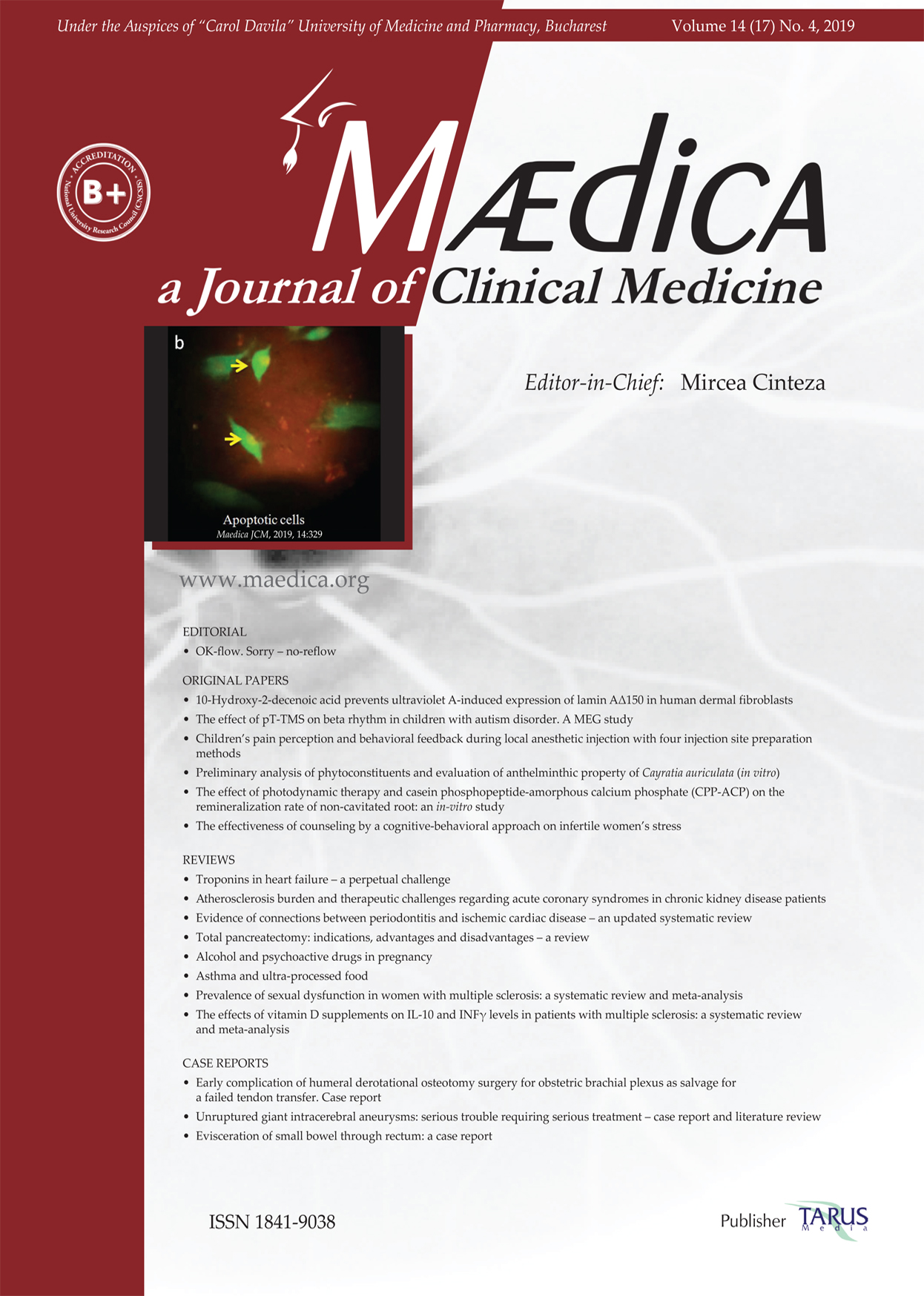
MÆDICA - a Journal of Clinical Medicine | Vol. 14, No. 4, 2019 CNCSIS - CMR - B+ OBBCSSR

Members Area


Asthma and Ultra-Processed Food

Anca Hâncu, Florin MIHALTAN and Gabriela RADULIAN

ABSTRACT

In the Decade of Nutrition, food must be reconsidered.
The main objective of our research was to establish if there are any correlations between ultraprocessed food consumption and increased asthma prevalence or other respiratory outcomes. Meanwhille, it will be an important step to design some lifestyle recommendations with direct benefits for asthma treatment. NOVA system for food classification is a new concept addressing food quality.
Ultraprocessed food, made entirely from substances derived from food and additives, that includes other sources of nutrients and energy, is not usually used in culinary preparation. How asthma outcomes are influenced by Western diet that contains a lot of processed food and what benefits could arise from the Mediterranean diet are subjects for interesting studies.
Substantial correlations have been established between unhealthy diets, especially Western diet, ultraprocessed foods and food allergies and asthma pathogenesis and control.
NOVA clasification of processing foods and dietary inflammatory index are helpful tools in early identifying of correct dietary approach in asthma.
More research in nutrition recommendations for asthma patients must be done and practical guidelines in nutritional interventions are future steps.
Keywords: ultraprocessed food, Mediterranean diet, Western diet, asthma outcomes, dietary inflammatory index, NOVA system for food classification

Full text | PDF

Short Update on C-Peptide and its Clinical Value

SELECT ISSUE


MÆDICA - a Journal of Clinical Medicine | Vol. 14, nr. 1, 2019
CNCSIS - CMR - B+ OBBCSSR

Members Area


Short Update on C-Peptide and its Clinical Value

Carmen NOVAC, Gabriela RADULIAN, Anca ORZAN and Mihaela BALGRADEAN

ABSTRACT

C-Peptide (“connecting” peptide – molecular formula C112H179N35O46) is a peptide made of 31 aminoacids, making the bond between A and B chains of insulin from the pro-insulin molecule. Pro-insulin is the precursor of the insulin that is synthesized in the beta-pancreatic cells. After its discovery in 1967 by Steiner et al, together with the discovery of insulin biosynthesis, C-peptide seemed to bring new benefits, having similar effects as those of insulin. Unfortunately, the subsequent studies have classified C-peptide as a biologically inactive peptide. After the ‘90s, however, both studies on animals and those on human subjects with type 1 diabetes where C-peptide had been administered showed that it played important biological parts in improving kidney function and nerve conduction velocity, as well as in increasing blood flow in muscles, skin, kidneys, thus being seen as a possible treatment for chronic complications of type 1 diabetes. Although for a long time C-peptide has been considered to be an inert biological product, recent research has emphasized its active biological function. C-peptide bonds to the membrane of certain types of cells (neuronal, endothelial, renal tubular cells, fibroblasts) through a surface receptor coupled with a G protein, and it determines multiple effects at the cellular level: it improves the quality of red cells, generating a better oxygenation of tissues; it has a vasodilator effect for muscles, skin, kidneys; it generates blood flow increase in skeletal muscles and at the skin level; it decreases glomerular hyper-filtering; it reduces albumin urinary excretion; it improves the function and structure of nerves in patients with type 1 diabetes and C-peptide deficiency, but not in healthy subjects. Therefore, C-peptide could have a therapeutic potential in preventing some of the late complications of diabetes mellitus.
Keywords: C-Peptide, G protein, diabetes mellitus, insulin secretion

Full text | PDF

Changes in Fasting Plasma Glucose, HbA1c and Triglycerides Are Related to Changes in Body Composition in Patients with Type 2 Diabetes

SELECT ISSUE

MÆDICA - a Journal of Clinical Medicine | Vol. 11, nr. 1, 2016 CNCSIS - CMR - B+ OBBCSSR

Members Area


Changes in Fasting Plasma Glucose, HbA1c and Triglycerides Are Related to Changes in Body Composition in Patients with Type 2 Diabetes

Anca Hâncu and Gabriela RADULIAN

ABSTRACT

Objectives: The objective of this analysis was to evaluate the relationship between the changes in the body composition and the changes in the glycemic control as evaluated by glycemia and glycated hemoglobin (HbA1c) and the lipid metabolism parameters in adults with type 2 diabetes.

Material and Methods: This was a retrospective cohort study, in which we collected data from the files of 171 patients with type 2 diabetes. The patients were followed for 6 months. Body composition (visceral fat area [VFA; cm], body fat mass [BFM, kg] and percent body fat [PBF; %] was assessed by bioelectric impedance. Delta parameters were calculated as the value of the parameter at month 0 minus the value of the parameter at month 3 or month 6.

Outcomes: All body composition parameters decreased significantly from baseline to month 3 and then to month 6. VFA decreased from 176. 26 cm2 at baseline to 151.21 cm² at month 3 and to 146.64 cm² at month 6. PBF decreased from 36.48% to 32.78% at month 3 and to 31.64% at month 6. BFM had a median value of 34.60 kg at baseline and decreased to 29.00 kg at month 3 and 27.95 kg at month 6. At 3 months, delta VAT and delta BFM were correlated with changes in glycemic control and lipid parameters. At 3 months only BFM remained correlated with these parameters.

Conclusion: In the population included in this analysis we showed that changes in VFA and BFM were correlated with changes in glycemic control during the 3-month follow-up period and that changes in BFM were correlated with changes in lipid parameters during the entire follow-up.

Keywords: type 2 diabetes, body composition, glycemic control, triglycerides

Full text | PDF


plic-mail[email protected]

 Terms and conditions

© MÆDICA - a Journal of Clinical Medicine - All rights reserved