MÆDICA - a Journal of Clinical Medicine Logo
  • Home
  • Profile
  • Standards
    • Types of articles
    • Instructions for authors
    • Editing rules (peer-review protocol)
    • Official Journal’s protocols
  • Editorial Council
  • Peer-review TEAM
  • How to
  • Menu

Author archives

  • About
  • Latest Posts

Radu BOTEZATU

Latest posts by Radu BOTEZATU (see all)

  • Pregnancy Management in Women with Antiphospholidic Syndrome - July 19, 2019
  • Laparoscopic Tubal Reanastomosis Outcomes – Case Reports - October 1, 2018

Articles signed on MÆDICA, JCM:

Pregnancy Management in Women with Antiphospholidic Syndrome

SELECT ISSUE


MÆDICA - a Journal of Clinical Medicine | Vol. 14, No. 2, 2019
CNCSIS - CMR - B+ OBBCSSR

Members Area


Pregnancy Management in Women with Antiphospholidic Syndrome

Andreea RADU, Stefan Cristian DUDU, Anca CIOBANU, Gheorghe PELTECU, George IANCU, Radu BOTEZATU, Nicolae GICA and Anca-Maria PANAITESCU

ABSTRACT

The antiphospholipid syndrome (APS or Hughes Syndrome) is a systemic autoimmune disease characterised by the presence of specific and persistent circulating antiphospholipid antibodies (APL) and the subsequent morbidities they cause, including pregnancy complications and thrombosis.
The three main antiphospholipid antibodies are: lupus anticoagulant (LA); anticardiolipin antibodies (aCL) IgG and IgM; and anti-β2-glycoprotein 1 IgG and IgM antibodies.
Antiphospholipid syndrome is associated with pregnancy complications such as recurrent early fetal loss, fetal death, preeclampsia (PE), and fetal growth restriction (FGR).
Although autoimmune disorders may have serious implication during pregnancy important advancements in pregnancy outcome have been reported in women with APL. The challenge arises in case of women refractory to conventional treatment (heparine/aspirin combination), which occurs in about 20-30% of cases. The management of pregnant women with non-criteria APS manifestations and that of APL carriers during their first pregnancy is also discussed.
This paper aims to discuss the risk stratification, clinical and pregnancy implications and current treatment strategies for pregnant women.
Keywords: autoimmune disease, antiphospholipid syndrome, antiphospholipid antibodies, recurrent miscarriages, thrombosis
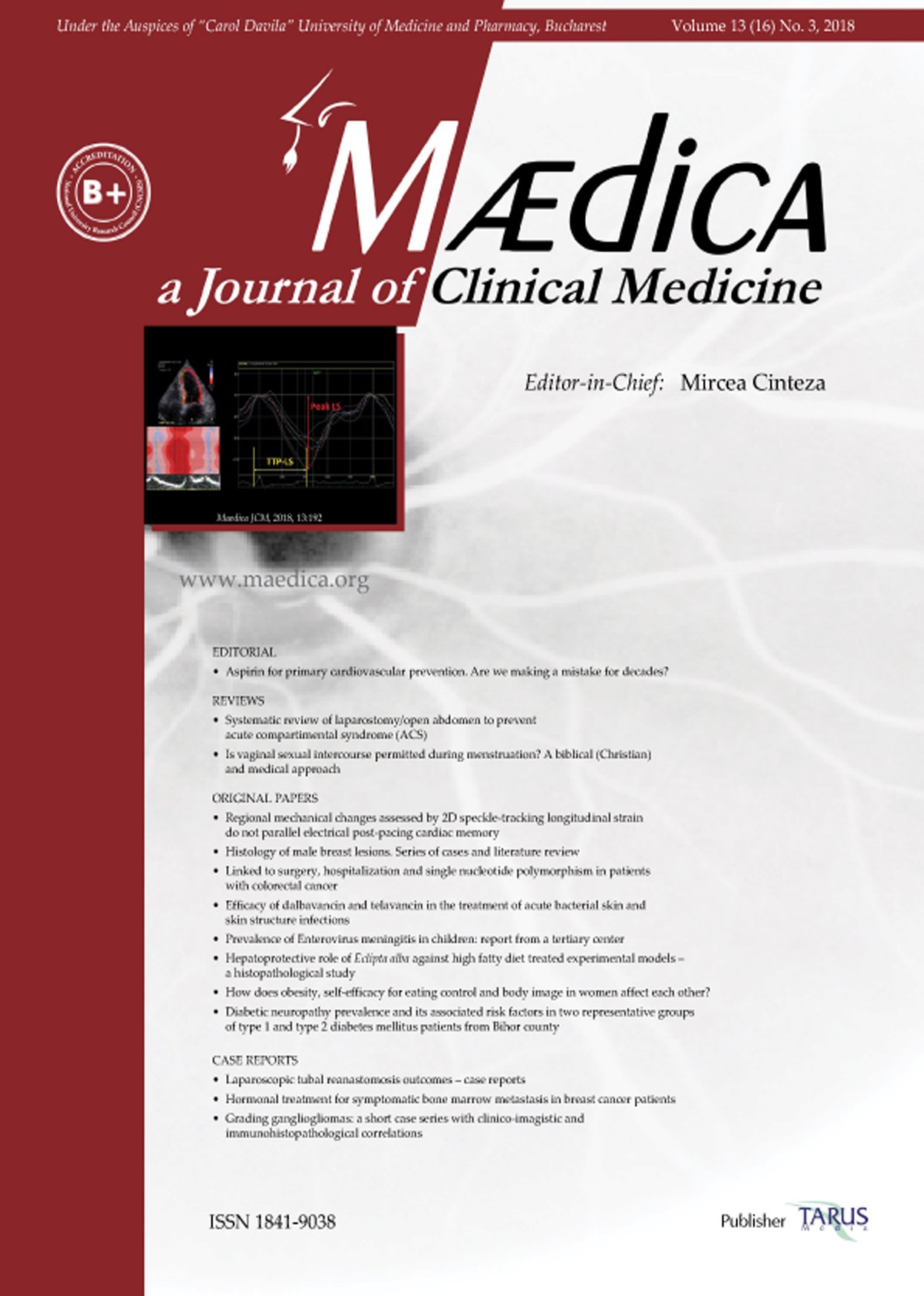
Full text | PDF

Laparoscopic Tubal Reanastomosis Outcomes – Case Reports

SELECT ISSUE


MÆDICA - a Journal of Clinical Medicine | Vol. 13, nr. 3, 2018
CNCSIS - CMR - B+ OBBCSSR

Members Area


Laparoscopic Tubal Reanastomosis Outcomes – Case Reports

Natalia Florina BUINOIU, Ana Maria PANAITESCU, Radu BOTEZATU, Corina MAT, Tiberiu Mihail DAIA, Gheorghe PELTECU and Nicolae GICA

ABSTRACT

Background. Encountered between methods of contraception, tubal sterilization is not a priority in Romania. Moreover, many women regret their decision a few years later. The aim of this study is to present the reproductive outcome reported in Filantropia Clinical Hospital after laparoscopic tubal reanastomosis.
Case reports. Here we present two cases which underwent laparoscopic reversal. The first case opted for reversal tubal ligation after seven years from her single cesarean section. Despite the unilateral recanalization achieved, the woman conceived after only six months. The second case was more challenging, taking into consideration the patient's medical history. Despite both tubes being permeable at the end of the procedure, the patient did not conceive at the time being.
Conclusion. Our experience confirms that laparoscopic tubal reanastomosis is also available in tertiary centers in Romania and could be a safe method for women who seek reversal, shortly after tubal sterilization.
The success rate is unknown due to the limited number of cases. Therefore, further research is required.
Keywords: laparoscopic tubal reanastomosis, tubal ligation, tubal recanalization.

Full text | PDF


plic-mail[email protected]

 Terms and conditions

© MÆDICA - a Journal of Clinical Medicine - All rights reserved