MÆDICA - a Journal of Clinical Medicine Logo
  • Home
  • Profile
  • Standards
    • Types of articles
    • Instructions for authors
    • Editing rules (peer-review protocol)
    • Official Journal’s protocols
  • Editorial Council
  • Peer-review TEAM
  • How to
  • Menu

Author archives

  • About
  • Latest Posts

Gheorghe PELTECU

Latest posts by Gheorghe PELTECU (see all)

  • Differential Diagnosis of Polyhydramnios in a Patient with Gestational Diabetes and Structurally Abnormal Fetus - October 17, 2019
  • Pregnancy Management in Women with Antiphospholidic Syndrome - July 19, 2019
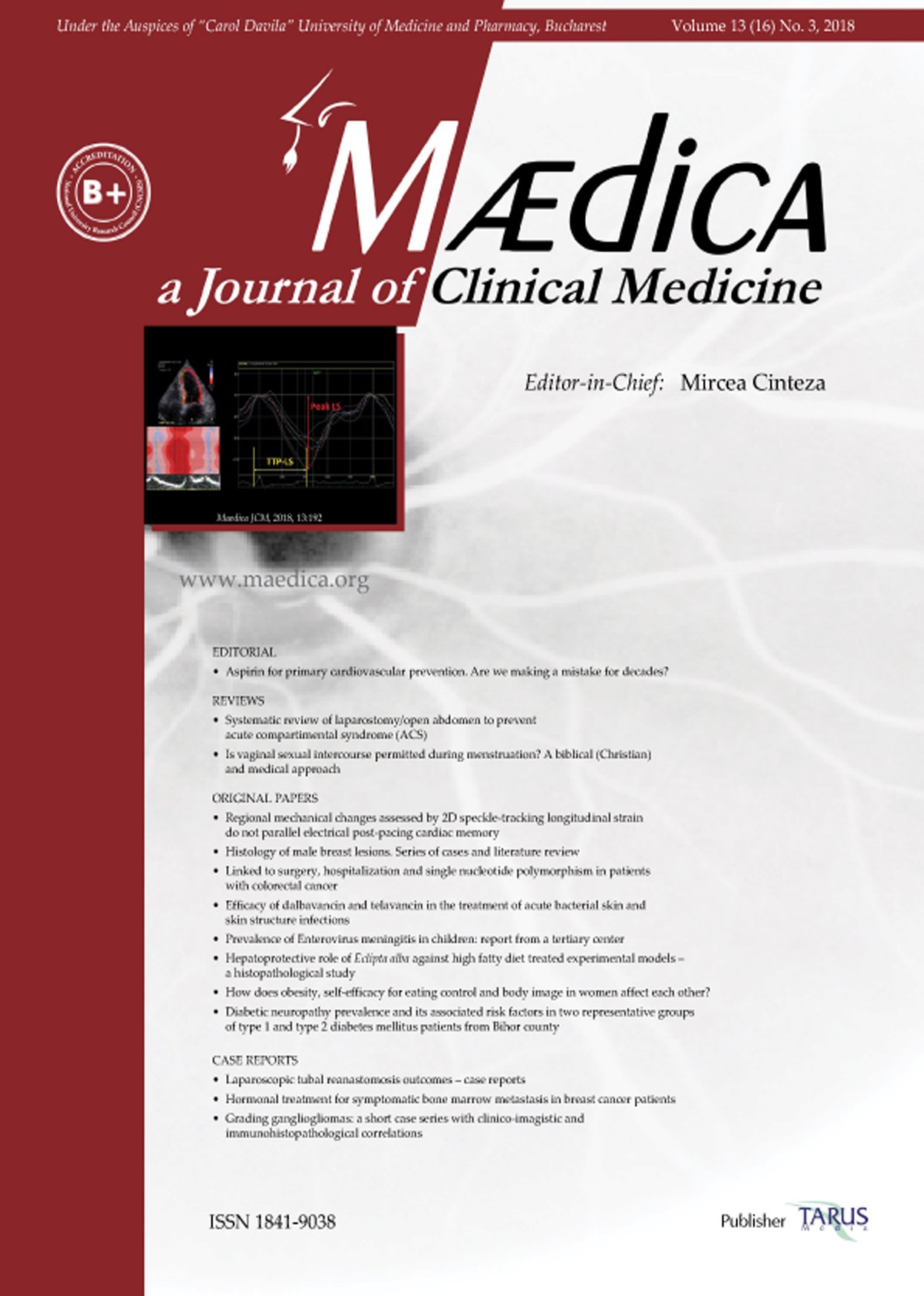
  • Laparoscopic Tubal Reanastomosis Outcomes – Case Reports - October 1, 2018

Articles signed on MÆDICA, JCM:

Differential Diagnosis of Polyhydramnios in a Patient with Gestational Diabetes and Structurally Abnormal Fetus

SELECT ISSUE


MÆDICA - a Journal of Clinical Medicine | Vol. 14, No. 3, 2019
CNCSIS - CMR - B+ OBBCSSR

Members Area


Differential Diagnosis of Polyhydramnios in a Patient with Gestational Diabetes and Structurally Abnormal Fetus

Nicolae GICA, Dominic Gabriel ILIESCU, Corina MAT, Anca Maria PANAITESCU, Gheorghe PELTECU and Alina VEDUTA

ABSTRACT

Polyhydramnios is frequently seen in patients with diabetes in pregnancy, as well as in cases of fetal malformations. The aim of our paper is to present a rare case of a fetus with anomalies of the precordial veins (absent ductus venosus, intracardiac drainage of the umbilical vein, persistent left superior vena cava) and upper intestinal tract obstruction. The mother developed gestational diabetes and polyhydramnios, in this case. The 29-year-old patient was admitted to our hospital at 35 weeks of gestation with ruptured membranes. Cesarean section was performed. A live baby boy, 2400 g, with multiple congenital abnormalities (including esophageal atresia) was delivered.
Our case illustrates the diagnostic approach to polyhydramnios and the difficulty to prenatally diagnose esophageal atresia, in the context of a fetus with multiple malformations.
Keywords: ductus venosus, esophageal atresia, gestational diabetes, polyhydramnios

Full text | PDF

Pregnancy Management in Women with Antiphospholidic Syndrome

SELECT ISSUE


MÆDICA - a Journal of Clinical Medicine | Vol. 14, No. 2, 2019
CNCSIS - CMR - B+ OBBCSSR

Members Area


Pregnancy Management in Women with Antiphospholidic Syndrome

Andreea RADU, Stefan Cristian DUDU, Anca CIOBANU, Gheorghe PELTECU, George IANCU, Radu BOTEZATU, Nicolae GICA and Anca-Maria PANAITESCU

ABSTRACT

The antiphospholipid syndrome (APS or Hughes Syndrome) is a systemic autoimmune disease characterised by the presence of specific and persistent circulating antiphospholipid antibodies (APL) and the subsequent morbidities they cause, including pregnancy complications and thrombosis.
The three main antiphospholipid antibodies are: lupus anticoagulant (LA); anticardiolipin antibodies (aCL) IgG and IgM; and anti-β2-glycoprotein 1 IgG and IgM antibodies.
Antiphospholipid syndrome is associated with pregnancy complications such as recurrent early fetal loss, fetal death, preeclampsia (PE), and fetal growth restriction (FGR).
Although autoimmune disorders may have serious implication during pregnancy important advancements in pregnancy outcome have been reported in women with APL. The challenge arises in case of women refractory to conventional treatment (heparine/aspirin combination), which occurs in about 20-30% of cases. The management of pregnant women with non-criteria APS manifestations and that of APL carriers during their first pregnancy is also discussed.
This paper aims to discuss the risk stratification, clinical and pregnancy implications and current treatment strategies for pregnant women.
Keywords: autoimmune disease, antiphospholipid syndrome, antiphospholipid antibodies, recurrent miscarriages, thrombosis

Full text | PDF

Laparoscopic Tubal Reanastomosis Outcomes – Case Reports

SELECT ISSUE


MÆDICA - a Journal of Clinical Medicine | Vol. 13, nr. 3, 2018
CNCSIS - CMR - B+ OBBCSSR

Members Area


Laparoscopic Tubal Reanastomosis Outcomes – Case Reports

Natalia Florina BUINOIU, Ana Maria PANAITESCU, Radu BOTEZATU, Corina MAT, Tiberiu Mihail DAIA, Gheorghe PELTECU and Nicolae GICA

ABSTRACT

Background. Encountered between methods of contraception, tubal sterilization is not a priority in Romania. Moreover, many women regret their decision a few years later. The aim of this study is to present the reproductive outcome reported in Filantropia Clinical Hospital after laparoscopic tubal reanastomosis.
Case reports. Here we present two cases which underwent laparoscopic reversal. The first case opted for reversal tubal ligation after seven years from her single cesarean section. Despite the unilateral recanalization achieved, the woman conceived after only six months. The second case was more challenging, taking into consideration the patient's medical history. Despite both tubes being permeable at the end of the procedure, the patient did not conceive at the time being.
Conclusion. Our experience confirms that laparoscopic tubal reanastomosis is also available in tertiary centers in Romania and could be a safe method for women who seek reversal, shortly after tubal sterilization.
The success rate is unknown due to the limited number of cases. Therefore, further research is required.
Keywords: laparoscopic tubal reanastomosis, tubal ligation, tubal recanalization.

Full text | PDF

Mode of Delivery in Stillbirth

SELECT ISSUE


MÆDICA - a Journal of Clinical Medicine | Vol. 12, nr. 2, 2017
CNCSIS - CMR - B+ OBBCSSR

Members Area


Mode of Delivery in Stillbirth

Natalia Florina BUINOIU, Sabrina Ioana STOICA, Corina MAT, Anca PANAITESCU, Gheorghe PELTECU and Nicolae GICA

ABSTRACT

Objective: In Romania, a national statistics report on the mode of delivery in pregnancies that ends in stillbirths has never been conducted. Thus, we decided to analyze the incidence of cesarean section versus vaginal delivery rate over a 10-year period in Filantropia Clinical Hospital of Bucharest.
Materials and Methods: We conducted a retrospective analysis over a period of 10 years from January 2005 to December 2015. Maternal age, parity, social status, place of origin, educational level, gestational age, fetal presentation and fetal sex were studied in order to see if there were a scientific correlation with death in utero.
Results: Between 2005 and 2015, Filantropia Clinical Hospital had a total of 31676 births after the 28th week of gestation. During this time period, 174 (0.55%) stillbirths were registered. The overall number of cesarean sections in live-births was 13199 (41.7%) and the rate of cesarean sections calculated for the stillbirth was 17.24% (30/174).
Conclusion: Our study revealed that the rate of cesarean sections in stillbirth had a dramatic decrease based on the adoption of guidelines reflecting evidence based medicine. The vast majority of pregnancies included in our study did not undergo standard perinatal tests and screenings that ensure a healthy and safe delivery, as it is a known fact that many causes of perinatal deaths can be prevented by health care access and perinatal regular visits. We suggest that a proper follow up in the last trimester and easy access to health care facilities can lower the incidence of stillbirths in Romania.

Keywords: stillbirth, cesarean section, vaginal birth, high-risk pregnancies

Full text | PDF

Managing Crohn’s Disease during Pregnancy

SELECT ISSUE

MÆDICA - a Journal of Clinical Medicine | Vol. 11, nr. 3, 2016 CNCSIS - CMR - B+ OBBCSSR

Members Area


Managing Crohn’s Disease during Pregnancy

Brindusa Ana CIMPOCA, Florina NEDELEA, Mirona FURTUNA, Gheorghe PELTECU and Anca Maria PANAITESCU

ABSTRACT

Crohn’s disease (CD) is a chronic inflammatory bowel disease with onset during reproductive age. Advancement in medical therapies and treatment strategies have made pregnancy following a diagnosis of CD a viable and safe option for more women with this disease. In this review we discuss the evidence based management of Crohn’s disease during pregnancy.
Keywords: Crohn’s disease, inflammatory bowel disease, pregnancy, preconception disease control

Full text | PDF

Thrombocytopenia in Pregnancy

SELECT ISSUE

MÆDICA - a Journal of Clinical Medicine | Vol. 11, nr. 1, 2016 CNCSIS - CMR - B+ OBBCSSR

Members Area


Thrombocytopenia in Pregnancy

Anca Marina CIOBANU, Simona COLIBABA, Brandusa CIMPOCA, Gheorghe PELTECU and Anca Maria PANAITESCU

ABSTRACT

Thrombocytopenia, defined as blood platelet count below 150,000/μL is the second leading cause of blood disorders in pregnancy after anemia. Gestational thrombocytopenia explains 70-80% of all cases of thrombocytopenia in pregnancy. Hypertensive disorders account for approximately 20% and immune thrombocytopenic purpura for about 3-4%. Other etiologies are considered rare in pregnancy.

The aim of this study is to review the specific causes of thrombocytopenia in pregnancy, their obstetrical implications and management.

Keywords: thrombocytopenia, pregnancy, gestational thrombocytopenia

Full text | PDF


plic-mail[email protected]

 Terms and conditions

© MÆDICA - a Journal of Clinical Medicine - All rights reserved