MÆDICA - a Journal of Clinical Medicine Logo
  • Home
  • Profile
  • Standards
    • Types of articles
    • Instructions for authors
    • Editing rules (peer-review protocol)
    • Official Journal’s protocols
  • Editorial Council
  • Peer-review TEAM
  • How to
  • Menu

Author archives

  • About
  • Latest Posts

Sayed Yousef MOJTAHEDI

Latest posts by Sayed Yousef MOJTAHEDI (see all)

  • Metabolic Disorders in Iranian Children with Urolithiasis - October 17, 2019
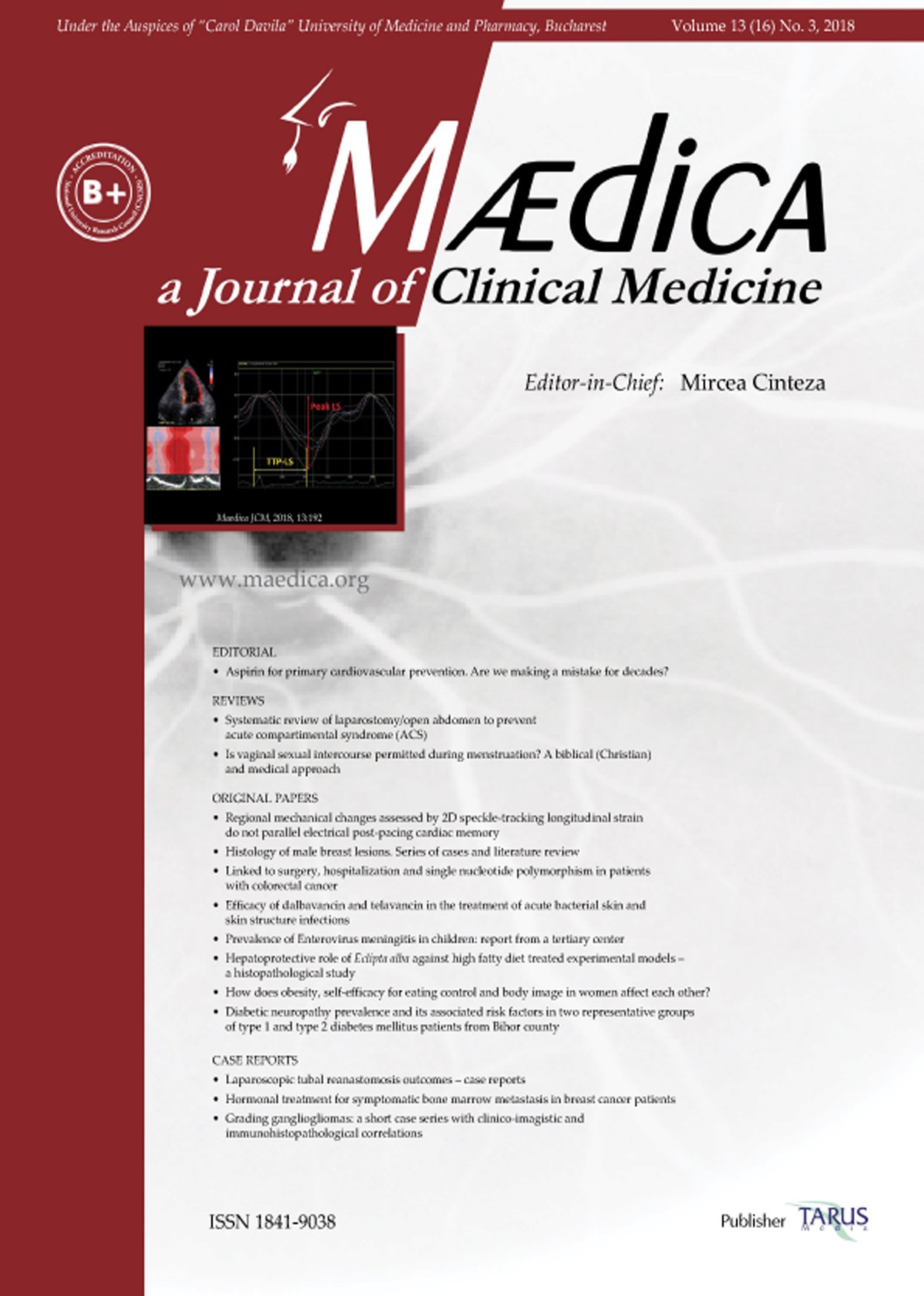
  • Prevalence of Enterovirus Meningitis in Children: Report from a Tertiary Center - October 1, 2018

Articles signed on MÆDICA, JCM:

Metabolic Disorders in Iranian Children with Urolithiasis

SELECT ISSUE


MÆDICA - a Journal of Clinical Medicine | Vol. 14, No. 3, 2019
CNCSIS - CMR - B+ OBBCSSR

Members Area


Metabolic Disorders in Iranian Children with Urolithiasis

Sayed Yousef MOJTAHEDI, Arash ABBASI, Anahita IZADI, Fahimeh Shahsavari ALAVIJE and Daryoush FAHIMI

ABSTRACT

Background: Children with urolithiasis have a wide range of metabolic disorders which should be carefully considered. The response to medical treatment could predict recurrence and need for surgical interventions.
Objectives: The goal of this retrospective study is to determine the prevalence of metabolic disorders in Iranian children and assess patients’ response to treatment based on the etiology of their urolithiasis.
Material and methods: Medical record of 100 children with urolithiasis who were referred to Bahrami hospital (affiliated hospital of Tehran University of Medical Sciences) between 2007 and 2017. Data regarding age, sex, family history, symptoms, size of the stones, type of treatments, response to treatment, and recurrence were recorded for all cases.
Results: Subjects had a mean age of 36 ±36 months and 62 (62%) of them were females. Twenty-two percent had a family history of urolithiasis. The mean age was 37.2±35 months in the complete response group, 38±44.4 months in the partial group, and 30±33.1 months in the no response group (p=0.7). There was no significant difference regarding sex and age with treatment response (p=0.8). In the complete response group, nearly 72% of cases had stones with sizes less than 3 mm. Three cases had surgical interventions and 18 had recurrence.
Conclusion: Hypercalciuria followed by hyperoxaluria were the most common metabolic disorders in Iranian children with urolithiasis. Stone size plays an important role in the response to treatment.
Keywords: urolithiasis, children, Iran
Full text | PDF

Prevalence of Enterovirus Meningitis in Children: Report from a Tertiary Center

SELECT ISSUE


MÆDICA - a Journal of Clinical Medicine | Vol. 13, nr. 3, 2018
CNCSIS - CMR - B+ OBBCSSR

Members Area


Prevalence of Enterovirus Meningitis in Children: Report from a Tertiary Center

Anahita IZADI, Ali Akbar RAHBARIMANESH, Yousef MOJTAHEDI and Sayed Yousef MOJTAHEDI

ABSTRACT

Meningitis is the most frequent infection of the central nervous system and viruses are the most common agents. Enteroviruses are among the most important causative agents. The goal of this study was to determine Coxsackievirus and echovirus infections in children referred to Bahrami Hospital with the diagnosis of meningitis. Forty children with the diagnosis of meningitis, who were referred between January 2017 and February 2018, were evaluated. Forty cases were evaluated. Twenty two (55%) were males and 18 (45%) females (M/F=2.1). The most common age group was 0-4 years and most cases were admitted in autumn and summer. Entroviruses are the causative agent of meningitis in 26 (65%) cases, including coxsackieviruse type B5 in 18 (69%) and coxsackieviruse type B4 in 2 (10%). Six meningitis cases were caused by echoviruses (30%). In both coxsackievirus and echovirus groups, the most frequent age group was less than four years. Among the 26 cases with enterovirus infection, three were admitted in spring (11.5%), eight in summer (30.7%), 10 in autumn (38.4%) and five (19.2%) in winter.
The most common symptoms in cases with entroviruses infection were fever in 26 (100%) patients and nausea/vomiting in 18 (69.2%). Entroviruses are among the most common viral infections leading to meningitis in Iranian children. Rapid diagnosis will result in early and proper treatment.
Keywords: meningitis, viral, children, Iran.

Full text | PDF


plic-mail[email protected]

 Terms and conditions

© MÆDICA - a Journal of Clinical Medicine - All rights reserved